> For the complete documentation index, see [llms.txt](https://interfacing.gitbook.io/interfacing-help-files/llms.txt). Markdown versions of documentation pages are available by appending `.md` to page URLs; this page is available as [Markdown](https://interfacing.gitbook.io/interfacing-help-files/learning-and-development/managing-trainings-apps/tracking-and-monitoring-trainings/training-dashboard.md).

# Training Dashboard

View training activity, completion trends, and compliance with interactive charts and metrics.

Use the **Training Dashboard** to track and analyze trainings. With it, you can:

* Track overall training completion
* Identify trends by training source
* Monitor employee compliance and timeliness

{% hint style="info" %}
**Navigation:** Go to **Apps** > **QMS Dashboards** > **Training Dashboard**.
{% endhint %}

***

{% stepper %}
{% step %}

### Viewing Dashboard Metrics

The dashboard displays several charts, each offering a different perspective on training performance and activity.

<table data-card-size="large" data-view="cards"><thead><tr><th align="center"></th><th>What It Shows</th><th>Use It To</th><th data-hidden data-card-cover data-type="image">Cover image</th></tr></thead><tbody><tr><td align="center"><strong>Total Trainings Completed per Month</strong></td><td>The number of trainings completed each month.</td><td>Identify completion trends and anticipate resource needs.</td><td></td></tr><tr><td align="center"><strong>No. of Trainings per Source</strong></td><td>The distribution of trainings by source (e.g., QE, CAPA, Action Item).</td><td>Understand which processes generate the most training activity.</td><td></td></tr><tr><td align="center"><strong>No. of Training Instances per Source</strong></td><td>The total number of training sessions delivered for each source.</td><td>Identify heavily utilized training drivers and balance workloads.</td><td></td></tr><tr><td align="center"><strong>No. of Training on Time per Employee in Selected Month</strong></td><td>The number of trainings each employee completed on time during the selected month.</td><td>Monitor individual compliance and punctuality.</td><td></td></tr><tr><td align="center"><strong>No. of Trainings Past Due per Employee in Selected Month</strong></td><td>The number of trainings past due for each employee in the selected month.</td><td>Quickly identify compliance risks and follow up as needed.</td><td></td></tr></tbody></table>

***

{% endstep %}

{% step %}

### Filtering Metrics

Use filters to refine the data displayed in the dashboard.

* **Date Range Filter** — Limit results in **Total Trainings Completed per Month**
* **Month Filter** — Focus employee performance charts on a specific month

{% hint style="warning" %}
The **Month** dropdown only displays months for which performance data is available.
{% endhint %}

After selecting your criteria, click **Filter** to refresh the charts.

***

{% endstep %}

{% step %}

### Interacting with Charts

Interact with charts to explore details and uncover specific data:

* **Hover** over data points (e.g., bars or pie slices) to view tooltips showing the category and item count.
* **Double-click** a data point to drill down from a summary view into a detailed list.
  * **Example:** Double-click the **CAPA** slice in the **Trainings per Source** chart to view all related trainings in a modal window.

***

{% endstep %}

{% step %}

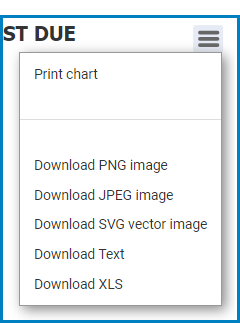
### Exporting or Downloading Charts

Export charts for reporting or offline use.

* Select the **hamburger menu** (<i class="fa-bars">:bars:</i>) in the top-right corner of the chart.
* Choose an export format:
  * PNG image
  * JPEG image
  * SVG vector image
  * Text file
  * XLS file

<figure><img src="https://manula.r.sizr.io/large/user/10696/img/audit-dashboard-3_v2.png" alt="" width="188"><figcaption></figcaption></figure>

***

{% endstep %}
{% endstepper %}

***


---

# Agent Instructions
This documentation is published with GitBook. GitBook is the documentation platform designed so that both humans and AI agents can read, navigate, and reason over technical content effectively. Learn more at gitbook.com.

## Querying This Documentation
If you need additional information that is not directly available in this page, you can query the documentation dynamically by asking a question.

Perform an HTTP GET request on the current page URL with the `ask` query parameter, and the optional `goal` query parameter:

```
GET https://interfacing.gitbook.io/interfacing-help-files/learning-and-development/managing-trainings-apps/tracking-and-monitoring-trainings/training-dashboard.md?ask=<question>&goal=<endgoal>
```

`ask` is the immediate question: it should be specific, self-contained, and written in natural language.
`goal` is optional and describes the broader end goal you are ultimately trying to accomplish on behalf of the user. GitBook uses it to tailor the answer towards what is most useful for that goal.

The response will contain a direct answer to the question and relevant excerpts and sources from the documentation.

Use this mechanism when the answer is not explicitly present in the current page, you need clarification or additional context, or you want to retrieve related documentation sections.